
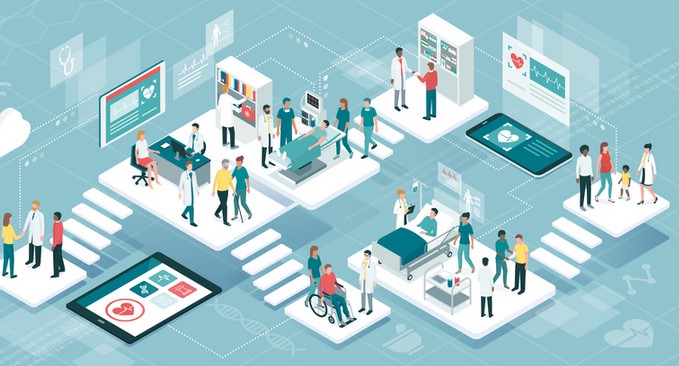
Imagine a nurse in a busy ward, carrying a tray of medications while an alarm blares from Room 302. In a traditional setting, she’d have to stop, check a central monitor, find a paper chart, and perhaps realize it was a “false alarm” caused by a loose sensor. That’s three minutes of wasted, high-stress time. In 2026, those three minutes are being reclaimed by technology that “thinks” alongside the medical staff.
I’ve spent over a decade walking the halls of medical facilities, often carrying a rugged laptop and a pocket full of USB cables. I’ve seen the transition from “digitized paperwork” to truly smart hospital systems. I remember a specific night shift during a pilot program where a system flagged a patient’s deteriorating vitals two hours before a human could have noticed the subtle trend. That wasn’t just “good tech”—it was a life saved.
The future of healthcare isn’t just about better medicine; it’s about better architecture. We are moving away from hospitals as buildings and toward hospitals as integrated ecosystems.
1. What Exactly Makes a Hospital “Smart”?
To the average visitor, a smart hospital might just look like a place with more tablets and shiny screens. But the real magic is invisible.
The Analogy: Think of a traditional hospital like a collection of solo musicians—the surgeon, the pharmacy, and the lab are all talented, but they are playing their own sheet music. A smart hospital system is the conductor. It ensures everyone is playing the same song, in the same key, at the same tempo, adjusting in real-time if someone misses a beat.
At its core, a smart hospital uses the Internet of Medical Things (IoMT) to connect every device, person, and data point within the facility.
2. The Pillars of Smart Hospital Systems: How They Work
To understand the impact, we need to look at the three technical pillars that hold these systems up.
The Internet of Medical Things (IoMT)
This is the network of physical devices—wearable heart monitors, smart beds, and even connected infusion pumps—that constantly stream data.
-
Real-time Insights: These devices don’t just record data; they analyze it.
-
Asset Tracking: Using RFID (Radio Frequency Identification), staff can find a missing ventilator or a clean wheelchair in seconds, rather than searching floors.
Edge Computing and “The Brain”
In healthcare, latency kills. If a patient stops breathing, you can’t wait for data to travel to a server in another country and back.
-
Edge Processing: Smart hospitals process critical data locally (at the “edge” of the network) to provide instant alerts.
-
Interoperability: This is the “holy grail” of HealthTech—ensuring that a heart monitor from Brand A can talk to an Electronic Health Record (EHR) from Brand B.
AI-Driven Predictive Analytics
This is where my 10 years of experience gets really exciting. We are moving from “What happened?” to “What will happen?”
-
Sepsis Prediction: AI models analyze heart rate, temperature, and lab results to predict sepsis—a leading cause of hospital death—hours before symptoms manifest.
-
Resource Management: Systems predict peak emergency room hours, allowing administrators to staff up before the rush begins.
3. Improving the Patient Experience: From Cold Rooms to Care Suites
We often focus on the doctors, but smart hospital systems are fundamentally changing how it feels to be a patient.
-
Environmental Control: Patients in 2026 can control their room’s lighting, temperature, and window shades via a bedside tablet. It sounds like a luxury, but reducing patient stress actually speeds up recovery.
-
Wayfinding: Large hospitals are mazes. Digital kiosks and mobile apps now provide turn-by-turn directions to the radiology lab, reducing the “where am I?” anxiety for patients and families.
-
Digital Front Doors: Integration starts before you arrive. Self-check-in via mobile devices and pre-visit virtual consultations ensure that when you walk in, the hospital is already ready for you.
4. The Technical Backbone: LSI and Security Terms
To build these systems, IT directors have to navigate a complex vocabulary. If you’re a professional in this space, you’re likely dealing with:
-
HL7 and FHIR Protocols: The international standards for transferring clinical and administrative data between software applications.
-
Software-Defined Networking (SDN): Allowing the hospital to prioritize “Life-Critical” data (like a heart monitor signal) over “General” data (like a guest using the guest Wi-Fi).
-
Cyber-Physical Systems: The intersection where computer algorithms control physical processes (like an automated pharmacy dispensing unit).
5. Expert Advice: The Reality of Implementation
As someone who has seen the “messy” side of tech deployments, here is my takeaway for anyone looking at this niche.
💡 Pro Tip: Focus on “Human-in-the-Loop”
The biggest mistake hospitals make is buying “Smart” tech that creates “Alarm Fatigue.” If a system pings a nurse 100 times a day for minor issues, she will eventually ignore the one that matters. A true smart system filters the noise and only alerts when action is required.
⚠️ The Cybersecurity Gap
Every “connected” device is a potential doorway for a hacker. In 2026, Legacy Equipment (old MRI machines or pumps) is the biggest risk. If it’s connected to the internet but running an outdated OS, it’s a target. Always insist on Micro-segmentation—keeping the medical devices on a completely separate, invisible network from the rest of the hospital.
6. The 2026 Smart Hospital Checklist
If you are evaluating a facility or a technology provider, look for these three things:
-
Unified Dashboarding: Can the staff see all patient data in one place, or do they have to log into five different apps?
-
Contactless Workflows: Are they using biometrics or NFC for secure access to medication and records?
-
Scalability: Is the system built on a Cloud-Native architecture that can grow, or is it stuck on a single physical server in the basement?
7. The Future: From Smart Hospitals to Smart Homes
The ultimate goal of a smart hospital system is actually to get you out of the hospital. By using Remote Patient Monitoring (RPM), hospitals can “hospitalize” you in your own bedroom.
Using the same sensors and cloud connectivity, doctors can monitor your recovery from miles away. This frees up beds for the critically ill while allowing patients to heal in the comfort of their own homes. It’s the ultimate expression of “connected technology for better care.”
Conclusion: The Leap Toward a Healthier Tomorrow
Smart hospital systems are no longer a “nice-to-have” luxury; they are the standard for 2026. By weaving together high-speed connectivity, artificial intelligence, and human-centric design, we are finally building healthcare environments that work as hard as the people inside them.
The transition isn’t always easy—it requires a massive shift in culture and a ruthless focus on cybersecurity—but the result is a world where medical errors decrease, and “care” becomes truly personal again.
Do you think technology makes healthcare feel more personal, or more robotic? I’ve seen it do both, and I’d love to hear your thoughts or experiences in the comments below!